

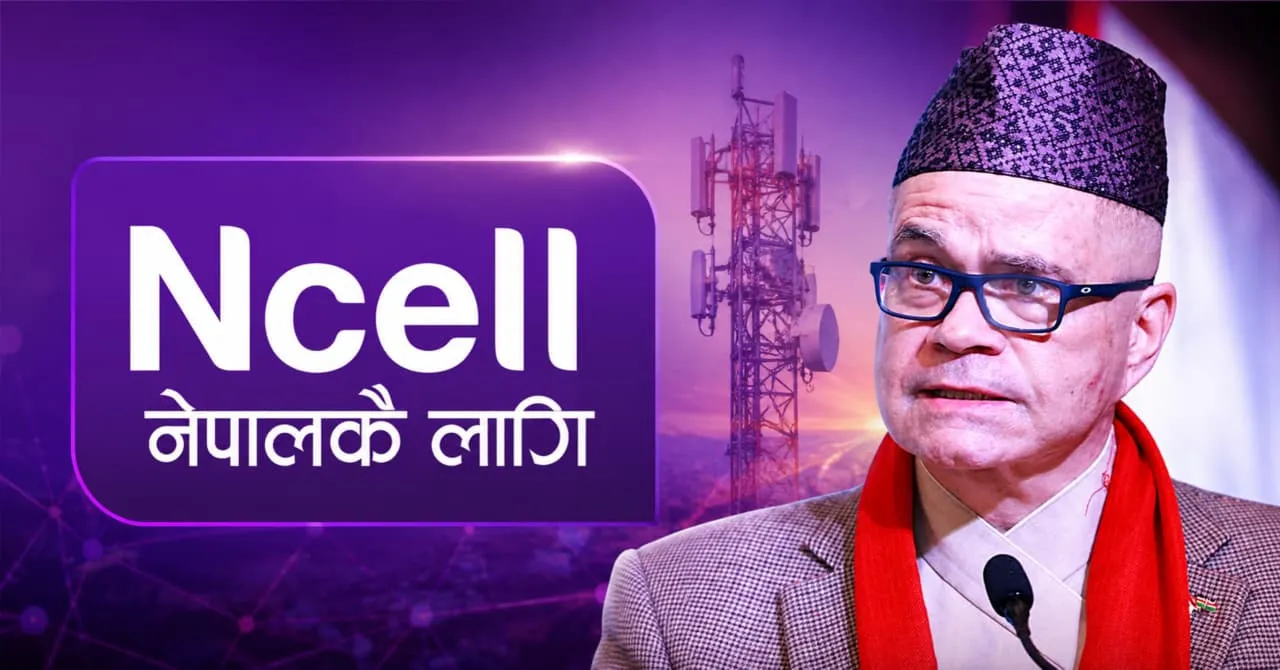
Kathmandu — Ncell Chief Executive Officer (CEO) Michael Foley has resigned from his position, citing what sources describe as an increasingly difficult environment for foreign investment in Nepal. Foley reportedly stepped down before completing even one year in office, expressing dissatisfaction over the difficulties of operating in Nepal and government policies and decisions concerning foreign investment.
Foley is reported to have submitted his resignation on Bhadra 9, and the company’s board of directors has already accepted it. Until a new CEO is appointed, Dilli Ram Shrestha, Ncell’s Chief Corporate and Regulatory Affairs Officer, has assumed the CEO’s responsibilities on an interim basis under a “Limits of Authority” arrangement.
According to sources, Foley’s dissatisfaction was linked to several issues, including Ncell’s foreign investment structure, the dispute surrounding its 25-year operating licence, government decisions concerning the company’s assets, and the legal and regulatory complications that have emerged in recent months. Sources also claim that family pressure contributed to his decision to leave Nepal.
Legal Disputes Increase Pressure on Board and Foreign Investors
Sources say Foley’s morale was also affected as Ncell’s board members and foreign investors became increasingly involved in various lawsuits and legal disputes.Foley had been advancing plans to expand Ncell’s high-speed 5G services, extend fibre-based internet connectivity to households, and increase investment in areas such as data centres.
He had also publicly stated that Ncell was prepared to invest approximately US$250 million more if the government provided the necessary facilitation.However, growing regulatory uncertainty and disputes surrounding investment have reportedly created uncertainty over those expansion plans.
Foley Unhappy With 25-Year Licence Provision
Foley had reportedly argued that the provisions governing Ncell’s 25-year operating licence were not attractive from the perspective of foreign investment. According to sources, he also believed that some of the decisions taken by the government were not consistent with existing laws.
Ncell had previously urged the government to review several of its decisions. The company has also reportedly objected to provisions under which its assets could eventually come under government ownership.
Latest Telecommunications Authority Directive Adds to Tensions
Amid the ongoing dispute between Ncell and the regulator, the Nepal Telecommunications Authority recently sent a letter to Ncell requiring the company to obtain prior approval before selling, transferring or pledging its assets as collateral.With only around three years remaining on Ncell’s current licence, the directive is understood to have created additional complications for the company’s future investment plans and financial management.
Under the directive, Ncell would not be able to sell, transfer or pledge its land, buildings, equipment, BTS towers and other physical and technical infrastructure to banks without prior approval from the telecommunications regulator.The company reportedly believes that the requirement could create difficulties even when it seeks to raise new investment or obtain loans to expand its infrastructure. There are concerns that such restrictions could eventually affect future service expansion and customer services.
Ncell Claims Risk of ‘Nationalisation’
Ncell has maintained that it should be allowed to make necessary changes to its foreign investment and shareholding structure to ensure the continued operation of its services even after the current licence period expires. The company has also reportedly stated that it would be willing to make shares available to interested Nepali citizens and institutions as part of such restructuring.
However, the company has accused the government of attempting to push Ncell toward forced nationalisation by introducing rules and provisions with retrospective effect.According to the company, such measures could be contrary to the spirit of the Telecommunications Act as well as the Foreign Investment and Technology Transfer Act, the Constitution of Nepal, and international treaties and agreements to which Nepal is a party.
Foley’s Resignation Raises Questions Over Nepal’s Investment Climate
Foley’s resignation is being viewed as more than a change in corporate leadership. It has also raised broader questions about the environment for foreign investment in Nepal, state regulation of the telecommunications sector, and the long-term security of major investments.Analysts say the departure of a senior executive of a major multinational company before completing his tenure, particularly when the investment and regulatory environment is cited as a reason, could send an unfavorable signal to potential foreign investors considering Nepal.
.webp)







Comments
You need to log in to comment.
Log In