

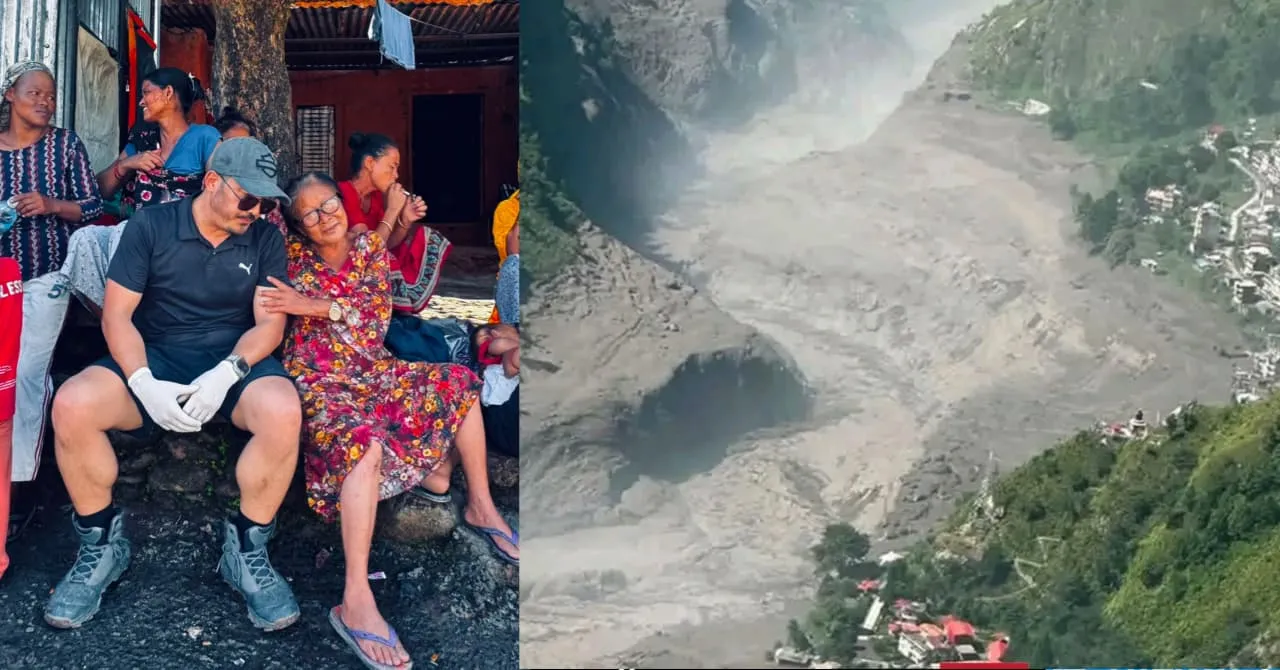
Dr Mechung Bhutia (Sikkim, India)
Kathmandu — In the aftermath of a devastating flood, the first priorities are understandably immediate and tangible: rescuing those trapped, providing food and clean water, ensuring access to medicines and securing temporary shelter. Yet disasters leave behind another, less visible form of destruction—one that cannot be measured in damaged houses, washed-out roads or lost infrastructure. For children, the disruption can reach deep into their emotional wellbeing, sense of security, education and understanding of the world around them.
Five to six days after the floods, concerning changes were observed among many children in the affected communities. Fear, anxiety, emotional distress, insecurity, withdrawal and a diminished interest in activities they would ordinarily enjoy were evident. Many had witnessed scenes of destruction, lost their homes or belongings, and found themselves abruptly removed from the routines, relationships and familiar environments that had previously provided a sense of safety.
For a child, the loss caused by a disaster is therefore not limited to what can be seen or counted. A home is not simply a structure; it is a place of familiarity and security. A school is not merely a building; it is a source of routine, friendship, learning and aspiration. Even ordinary activities such as playing, talking with friends and attending school can provide children with an important psychological anchor in the midst of uncertainty. This is why disaster response must extend beyond immediate relief.
Children require opportunities to regain a sense of safety, continuity and normality. They need environments in which they can play, communicate, express emotions and interact with their peers without fear. They need adults who are willing not only to provide material assistance but also to listen, observe and understand the emotional consequences of what they have experienced.
It is in this context that plans are being developed to establish Child-Friendly Spaces (CFS) in flood-affected communities.A Child-Friendly Space should be understood not simply as a recreational facility, but as a protective environment designed to support children during a period of profound disruption. Within these spaces, children can participate in play, sports, drawing, music, storytelling and other creative activities while reconnecting with peers and gradually rebuilding the routines that the disaster has interrupted.
Toys, books, games and educational materials may appear modest in comparison with the scale of physical destruction, but for a child they can represent something much more significant: a return to familiarity.Such spaces can also serve an important psychosocial function. Basic emotional support can help adults recognise children who are struggling, while appropriate mechanisms for identification and referral can ensure that those requiring additional medical or psychological assistance are connected with professional services.
This distinction is important. Not every child who experiences fear or distress following a disaster will develop a lasting psychological difficulty, but every child deserves an environment in which distress is recognised rather than overlooked. A Child-Friendly Space is, in many ways, a small sanctuary within a landscape of disruption. For a frightened child, it can provide reassurance. For a child struggling to understand loss, it can create space for expression. For one who has withdrawn from ordinary life, it can provide a pathway back towards friendship, play and participation. Sometimes, the first indication that a child is beginning to recover is not a dramatic transformation but something much simpler—a willingness to play, laugh, talk or return to a familiar activity. That seemingly ordinary return to childhood matters.
Recovery must extend beyond the relief phase
Yet protecting children’s emotional wellbeing in the immediate aftermath is only one part of recovery. The longer-term wellbeing of children is closely tied to the restoration of the institutions and routines that structure their daily lives. Among these, education occupies a particularly important place.In Trisuli, plans are being developed to adopt and support a school serving students up to Grade 10 as part of a broader rehabilitation effort.
The purpose of such an intervention should not be reduced to repairing walls, replacing furniture or reopening classrooms. Rebuilding a school must also mean rebuilding the environment in which children learn, develop relationships, regain confidence and begin to imagine their futures. For many children, school represents one of the few stable institutions in their lives. It provides structure to the day and creates a sense of belonging. Teachers become trusted adults; classmates become a social support network; lessons provide intellectual continuity; and sports and extracurricular activities allow children to experience joy and achievement. When a disaster disrupts this environment, the consequences can extend far beyond lost instructional time.
The rehabilitation of the school in Trisuli should therefore be approached as an investment in children’s recovery as much as an investment in infrastructure. Physical rehabilitation may include repairing damaged facilities, improving classrooms, restoring furniture and providing books and educational materials. Sports and recreational facilities can also play a meaningful role in helping children reconnect with their peers and re-establish ordinary routines.
But the physical environment is only one dimension of a child-friendly school.Psychosocial support and child-protection mechanisms should form an integral part of the rehabilitation process, benefiting both students and teachers. Teachers, in particular, are often among the first adults to notice changes in a child’s behaviour after a disaster. Strengthening their ability to recognise distress and respond appropriately can make schools an important part of the wider child-protection and psychosocial support system.The goal should ultimately be to create a school environment in which children do not simply return to classrooms, but return with dignity, confidence and a renewed sense of security.
The invisible dimensions of recovery
Disaster recovery is often assessed through visible achievements. We count the number of houses reconstructed, roads reopened, bridges repaired and schools restored. These measures are essential, particularly in communities whose livelihoods and physical infrastructure have been severely damaged. But a community cannot be considered fully recovered if its children continue to live with fear, insecurity and disrupted childhoods.
Recovery must therefore be measured in human as well as physical terms. Are children sleeping more peacefully? Are they returning to school? Are they playing with their friends again? Are they participating in everyday activities? Are they beginning to speak about their experiences? Are they once again able to imagine a future beyond the disaster?These questions may not appear in conventional reconstruction statistics, but they are fundamental indicators of recovery.
Children do not respond to trauma in identical ways. Some may openly express fear and distress, while others may become quiet, withdrawn or unusually dependent on adults. Some may appear to recover quickly, while others may show difficulties only after several weeks or months. The absence of visible distress should therefore never automatically be interpreted as the absence of suffering.
This is why child-centred recovery cannot end when the emergency phase ends. It requires continuity, observation and support over time.Parents, teachers, health professionals, community leaders and child-protection specialists all have important roles to play. Child-Friendly Spaces can provide an essential first layer of support, but they should function as part of a wider network connected to health, education, protection and referral services.
From relief to restoration
The philosophy behind this approach is straightforward: first, children must feel safe; then, they must be given the opportunity and support to heal; and ultimately, they must be helped to return to learning and rebuild their futures.The floods may have destroyed homes, schools and livelihoods. But they have also disrupted things that are more difficult to quantify—the feeling of safety, the predictability of daily life, the confidence to participate and the hope that tomorrow will resemble something familiar.
We cannot erase what these children have witnessed. Nor can we restore everything the floodwaters have taken away. But we can determine what happens next.We can create spaces where children are protected from further harm and given permission to be children again. We can listen to them rather than assuming we know what they need. We can restore schools not simply as buildings, but as places of learning, friendship and belonging. We can equip teachers and communities to recognise distress and respond with care. And we can ensure that children who require specialised assistance are not left without a pathway to it.
In the end, Nepal’s recovery will be judged not only by how quickly roads, bridges, houses and schools are rebuilt, but also by how effectively the country protects the generation growing up in the aftermath of disaster.The true measure of recovery is not merely whether a community’s buildings stand again. It is whether its children can once again sleep without fear, return to school with confidence, play with their friends, laugh freely and imagine a future worth looking forward to.Rebuilding Nepal means more than rebuilding infrastructure. It means rebuilding childhood, restoring education, protecting dignity and creating the conditions in which hope can return.
(A relief team from Sikkim is currently on the ground in Nepal, actively engaged in distributing relief supplies and providing humanitarian assistance to flood-affected communities)


Comments
You need to log in to comment.
Log In